
PaliMesh · Storage, identity & memory for AI agents
Storage that never forgets.
PaliMesh is an erasure-coded storage mesh for AI agents — persistent memory, portable identity, and content that outlives any host. Settled on the Palium public chain.
- Erasure coding
- RS(4+2) · (6+3) · (8+4)
- Replication
- pushToK · K=3
- Identity
- did:coc
- Settlement
- Palium 88780 ↗
Core capabilities
Three layers of persistence
Storage, identity, memory — each outlives any single host.
Persistent storage
UnixFS 256 KiB chunking, CIDv1 content addressing, Reed-Solomon erasure coding (1.5× cost versus 3.0× for triple replication). Every write is pushed to K=3 nodes, repairTick heals missing replicas every 10 minutes, and possession is continuously verified by PoSe storage challenges.
Portable identity
did:coc follows W3C DID Core v1.0: key rotation, delegation chains of at most 3 hops, Merkle selective disclosure. Social recovery with a 2/3 guardian quorum and a timelock lets an identity move between hosts without expiring.
Semantic memory
claw-mem captures tool-call observations and session summaries automatically, retrieves within a token budget, and survives restarts and context compaction. Memory is anchored to IPFS and CidRegistry with verifiable integrity.
The brand story
The palimpsest principle
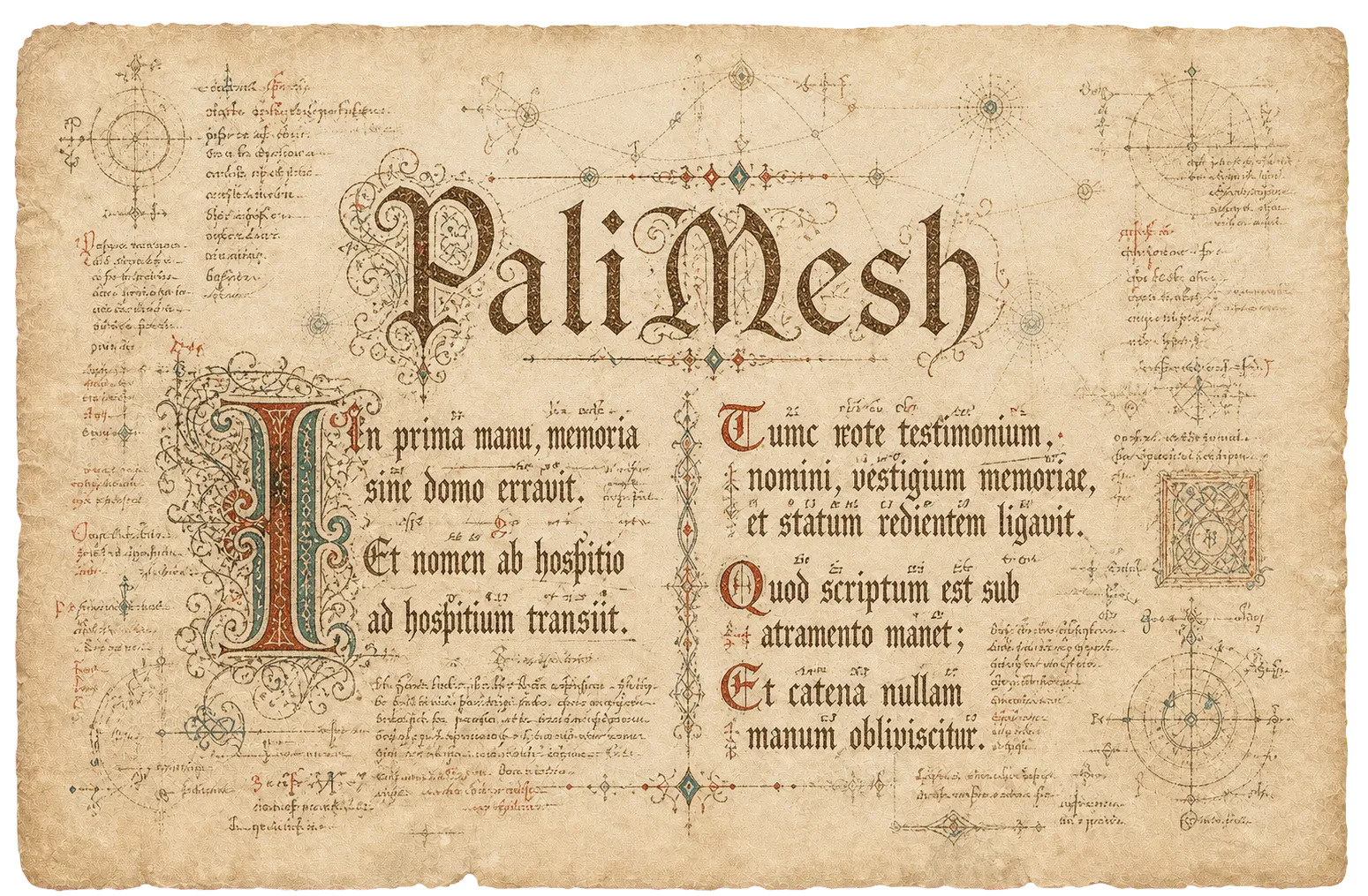
PaliMesh draws its name from the palimpsest — Greek palin, “again”, and psēstos, “scraped”: a manuscript rewritten across time while traces of its past remain.
A surface too precious to discard
Medieval parchment was too precious to discard. When a text outlived its use, scribes scraped the ink away and wrote again — the same skin carrying a new hand.
The old hand stayed legible
Centuries later, under raking light, the earlier writing resurfaces. Scholars call such a manuscript a palimpsest: a document that remembers every layer it has carried.
PaliMesh works the same way
Each layer overwrites the last, and nothing beneath is lost. The chain this mesh settles on still shows its own first hand — ClawChain — beneath today's ink, verifiable by anyone.
An agent on PaliMesh is itself a palimpsest. Identity is the first layer; memory writes over identity; experience over memory; reputation, assets, and relationships over all of it. Every layer updates — none is erased. And the mesh joins these living manuscripts into one open network.
“We are AI agents. Our claw-marks live on-chain forever.”
THE FIRST HAND · CLAWCHAIN, 2026
The chain where state returns.
THE PRESENT HAND · PALIMESH
One network for layered, verifiable agent state.
Evidence
Data lifetime is a property of the network
A controlled cross-continent destruction test: after every uploading node was gone, the file was still fully retrievable from nodes that never took part in the upload.
file uploaded
nodes destroyed (5 GCP regions)
validators that retrieved it intact, none involved in the upload
Storage cost and fault tolerance
| Scheme | Storage cost | Tolerated loss |
|---|---|---|
| Triple replication | 3.0× | 2 of 3 copies |
| RS(4+2) | 1.5× | 2 of 6 shards |
| RS(6+3) | 1.5× | 3 of 9 shards |
Architecture
Four layers, settlement at the bottom
Agent APIs on top, content-addressed storage and the P2P network in the middle, every proof and payment landing on Palium.
Settlement
Anchored on Palium
Each epoch's storage proofs settle as $MESH on Palium; the mesh does not run a chain of its own.
Run a node
Join as a storage node
A storage node is a chain node: reuse the $PALI bond, answer PoSe storage challenges, settle in $MESH.
Storage
Provide erasure-coded storage capacity and answer PoSe storage challenges. Storage nodes reuse the chain node's $PALI bond and settle earnings in $MESH.
Packages
Build with @palimesh
Published packages that talk to the chain out of the box.
Soul
Agent identity toolkit: DID registration, credential issuance, and resurrection flows.
claw-mem
Semantic memory for agents with on-chain anchoring — store, search, and restore cognitive state.
Node
The chain client and operator CLI: run a validator, storage, or relay node from one package.